Here is a view that tends to be unpopular with vendors selling AI tools. Most enterprises do not have an AI problem at all. They have a foundation problem in disguise. Consider where things actually break. The pilot that never reaches production. The agent that answers with complete confidence and gets it wrong. The personalization engine that somehow never feels personal. Almost none of that traces back to the model. It traces back to the tangle of systems and data sitting underneath, which was never built with intelligence at scale in mind.
That is the uncomfortable reality of AI transformation in 2026. The technology on top keeps improving. The infrastructure underneath, in most organizations, looks much as it did five years ago, just as siloed and just as fragile. AI does not paper over that. It brings it into the light. Point a genuinely capable model at stale, contradictory data scattered across a dozen systems that barely acknowledge each other, and it will amplify the mess rather than resolve it. The demonstration that impressed the boardroom quietly falls apart the moment it meets production data.
So the argument here is straightforward. Enterprise modernization is not a preliminary step to complete before the real AI work begins. It is AI work. Everything else is secondary.
The Industry Is Selling the Wrong Instruction
The message everywhere right now is to buy more AI. More models, more copilots, more agents, more seats on the license. It sells well, and it is easy to act on, because signing the contract feels like momentum. The problem is that it answers a question nobody should be asking. The question worth asking is not which model to buy. It is whether the systems underneath can support what you are about to ask the model to do.
Usually they cannot, and no amount of spend on the model changes that. Layer agents onto a legacy core and you begin paying a legacy tax before the AI delivers a single useful result. Every workaround, every brittle integration, every silo that should never have existed becomes a cost the initiative inherits on day one. The model was never the bottleneck. The foundation is. Buying more of what sits on top of the bottleneck does nothing to relieve it.
This is where much of that vanished AI budget goes. Not to failed technology, but to technology aimed at a foundation that could not support it. The organizations that will look back on this period as money well spent are the ones that resisted the urge to buy more intelligence and instead fixed the thing the intelligence depends on.
Why AI Exposes Every Weakness Beneath It
AI is unforgiving of a weak foundation, and it is worth understanding why. Ordinary software operates within defined paths. It works with the data it is handed, along the routes someone programmed. AI does not stay within those bounds. It reasons across whatever it can reach, and it trusts what it reaches. That assumption is where most enterprise AI quietly breaks down.
Take siloed data. A model that cannot see the whole customer, the whole transaction, the whole risk ends up reasoning from fragments, and fragments produce answers that are confident and wrong. Or take applications that only communicate through brittle point-to-point integrations. An agent trying to act across the business hits the first system boundary and stops. Then there is stale, ungoverned data, where every decision downstream inherits the unreliability, and the more autonomy the AI has, the more damage that does.
None of that is a model problem. It is a foundation problem. It stayed hidden for years because people quietly absorbed it, reconciling systems by hand, patching gaps with judgment, doing the invisible work that kept everything running. AI removes that human buffer and runs straight into the weakness at full speed. That is precisely why modernization stopped being an IT line item and became the thing that decides whether AI transformation works at all.
Modernization Is the AI Strategy
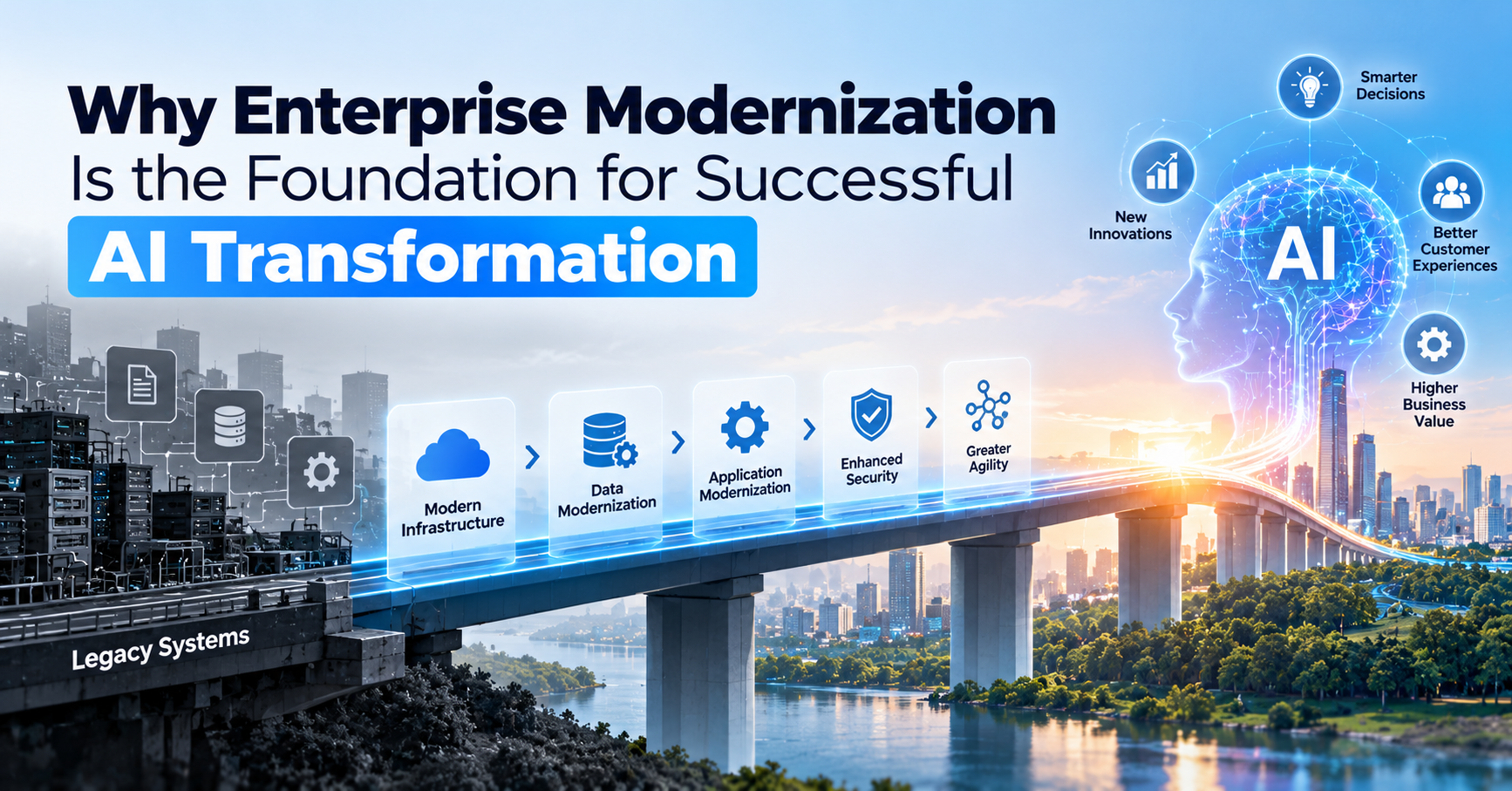
So here is the reframe. In the AI era, modernization is not something you do instead of AI transformation, and it is not a box to tick on the way to the interesting part. Modernization is AI transformation. The foundation and the intelligence were never two separate projects. They are one project, and the foundation is the half that decides whether intelligence is worth anything.
Getting that foundation right means treating three layers as one effort rather than three separate wins. Applications need to move toward connected, API-first designs, so new services and AI agents can use what already exists without a ground-up rebuild. The cloud and platform layer has to deliver the elastic, automated infrastructure AI workloads demand. And then there is data, the layer almost everyone underestimates. It has to be clean, governed, accessible, and traceable, because a model running on dark, siloed data will underperform no matter how capable it is.
Ciklum's legacy modernization practice is built around that principle, and around doing it in steps rather than a single high-risk rewrite. The point is not to modernize the entire estate before touching AI. It is to modernize the specific application and data layer a high-value workflow depends on, deploy AI against that clean foundation, and then reuse it for the next use case. Build the foundation once, apply it many times, and each new AI capability becomes cheaper rather than more expensive.
What the Foundation-First Enterprises Do Differently
The organizations pulling real returns out of AI share a discipline, and it has nothing to do with owning the most models.
They fix the data layer before they chase a use case. The customer-facing feature is what gets the attention. But the unglamorous work of unifying, cleaning, and governing data is what decides whether that feature survives contact with production. Foundation-first companies do the unglamorous part first. They have watched enough pilots fail on fragmented data to know the model was never going to save them.
They modernize in increments and keep the business running throughout. Instead of betting everything on a big-bang rewrite, they stand up the modern capability alongside the old system, move one workflow across, and retire the risk piece by piece. That approach also makes AI adoption safer, because the intelligence lands on a foundation already proven in production rather than on an untested new stack.
They treat engineering as something AI genuinely reshapes, not just something it speeds up. AI-enabled engineering services weave intelligence through the delivery lifecycle, but the discipline underneath still matters more than the tooling. AI-generated code dropped onto a weak platform simply produces new debt faster. A solid foundation is what lets AI accelerate delivery without compromising quality.
They bring AI in after the foundation is unified, function by function. Once the data and governance are in place, adoption spreads across finance, service, operations, and engineering, because they all draw on the same layer.
In Summary
The industry keeps calling 2026 the year to buy more AI. That is the wrong instruction. A large share of that spend will be wasted, and not because the models are weak. It is because they are being stacked on foundations that cannot hold them. AI will not resolve a fragmented, siloed, fragile estate. It will expose it, then amplify the mess at full speed.
The companies that get ahead will not be the ones with the most models or the largest AI budgets. They will be the ones with the discipline to modernize applications, data, and operations first, in increments, without ever stopping the business, and then let AI compound on top of a foundation built to support it. In the AI era, modernization is not the step before the strategy. It is the strategy.
About the author
- I write about enterprise AI, automation, and data platforms, with a focus on real-world implementation. My work explores how engineering teams design, build, and scale digital systems—covering architecture, challenges, and practical trade-offs. I share clear, actionable insights for builders, tech leaders, and teams working on modern systems.
Comments
Join the discussionNo comments yet. Be the first to comment.

